
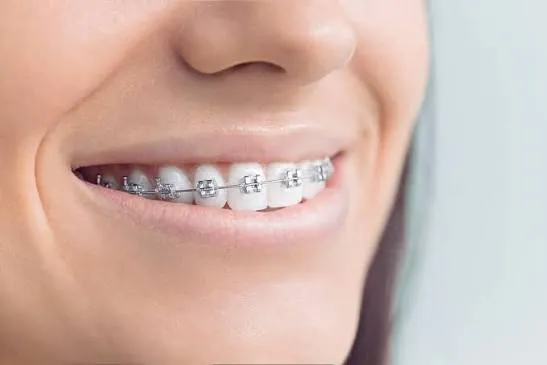
Traditional braces — cost, pros, and cons
Traditional braces use brackets bonded to each tooth, connected by a wire that’s gradually tightened to move teeth into position over time. At Revive Dental we offer two types: metal braces and ceramic braces.
✓ Advantages
- Most affordable orthodontic option
- Works for nearly any alignment or bite issue, including complex cases
- Fixed in place — no discipline needed to “remember to wear it”
- Ceramic braces offer a tooth-coloured, less visible alternative to metal
✗ Considerations
- Visible on teeth (metal more than ceramic)
- Requires care around sticky, hard, or chewy foods
- Harder to floss and clean around brackets and wires
- Periodic in-clinic adjustment visits every 4-6 weeks
Best suited for: patients with more complex bite corrections, growing children and teenagers, and anyone prioritising cost. Ceramic braces cost and benefits fall between metal braces and aligners — a good middle ground if visibility matters but budget is still a factor. Read more on our Orthodontics page.
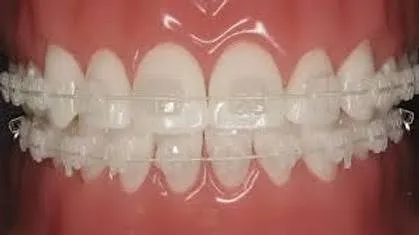
Clear aligners (Invisalign-style) — cost, pros, and cons
Clear aligners are a series of custom-made, removable plastic trays that gradually shift teeth into position, each worn for about 1-2 weeks before moving to the next in the series. They’re a popular choice for patients who want straighter teeth without visible metal.
✓ Advantages
- Nearly invisible — most people won’t notice you’re wearing them
- Removable for eating, brushing, and special occasions
- No food restrictions since trays come out to eat
- Generally more comfortable — no brackets or wires to irritate cheeks
✗ Considerations
- Higher cost than metal or ceramic braces
- Requires discipline — must be worn 20-22 hours a day to stay on track
- Not ideal for very complex bite corrections
- Easy to misplace since they’re removable
Best suited for: adults and teenagers with mild-to-moderate misalignment who want a discreet option and are disciplined about wear time. If you’re comparing invisalign vs metal braces specifically for visibility at work or in social settings, aligners are usually the more comfortable social choice.
Not sure which suits your bite? A quick exam tells us most of what we need to know.
Braces vs aligners: side-by-side comparison
| Factor | Metal/Ceramic Braces | Clear Aligners |
|---|---|---|
| Upfront cost | Lower | Higher |
| Visibility | Visible (ceramic less so) | Nearly invisible |
| Removable | No — fixed | Yes |
| Best for | Complex bite corrections | Mild-to-moderate corrections |
| Food restrictions | Yes — avoid sticky/hard foods | None — remove to eat |
| Discipline required | Low — fixed in place | High — 20-22 hrs/day wear |
| Typical treatment time | 12-24 months | 6-18 months (mild cases faster) |
Exact treatment time and cost depend on how much correction is needed — a consultation with an X-ray and bite assessment at Revive Dental gives you a precise, personalised recommendation rather than a generic estimate.
Which is right for your bite and lifestyle?
Ask yourself three questions: How complex is my bite correction? Severe crowding, rotated teeth, or major bite issues usually respond better to fixed braces. How much does visibility matter to me? If you’re in a client-facing role or simply prefer a discreet option, aligners have the edge. Can I commit to wearing something 20+ hours a day? If discipline around wear time is a concern, fixed braces remove that variable entirely since they can’t be taken off.
What orthodontic treatment looks like at Revive Dental

Dr. Roopa P Gaddagimath, BDS, MDS (Restorative & Cosmetic Dentistry)
“The first visit is always a proper bite assessment and X-ray — not a sales pitch for one option over another. For a teenager with significant crowding, I’ll usually recommend braces since there’s no compliance risk. For a working professional with mild spacing who’s disciplined about routines, aligners often make more sense. I walk every patient through both options honestly, including the trade-offs, before we decide together.”
Treatment typically starts with a consultation and X-ray, followed by a custom plan — braces are fitted in a single visit with adjustments every 4-6 weeks, while aligner trays are issued in batches with check-ins roughly every 6-8 weeks. With over 18 years of clinical experience and 5,000+ patients treated, Dr. Roopa plans each case around your specific bite, not a one-size-fits-all protocol.
Braces and Invisalign cost in Bangalore
Braces cost in Bangalore is generally the most budget-friendly starting point, with ceramic braces priced a step above metal for a less visible look. Invisalign cost in Bangalore and other clear aligner systems sit higher, since each tray is custom-manufactured for your teeth across the full treatment series. Exact pricing depends on case complexity, treatment duration, and which aligner brand or bracket system is used — Revive Dental gives you an exact quote only after a clinical exam and X-ray, since publishing a single number online wouldn’t be an accurate reflection of your specific case.
Orthodontists & braces specialists near you
Revive Dental is located on 100 Feet Road, Vajarahalli, Banashankari 6th Stage, and is regularly searched as an orthodontist in Thalaghattapura and best orthodontist in Konanakunte by patients across South Bangalore:
Thalaghattapura & Konanakunte
- Orthodontist in Thalaghattapura — consultations and bite assessments
- Best orthodontist in Konanakunte — braces and aligner planning
- Invisalign dentist in Banashankari 6th Stage for discreet correction
Doddakallasandra & Raghuvanahalli
- Braces treatment in Doddakallasandra — for children, teens and adults
- Best braces treatment in Raghuvanahalli — fitting and follow-up visits
- Braces specialist near me — same-day consultation slots
We’re also a regular choice for dental aligners in Balaji Layout and best dental aligners in Vajarahalli, plus the best Invisalign dentist in Thalaghattapura search — patients travel in from Uttarahalli and elsewhere along the Kanakapura Road corridor too. Explore our Orthodontics page or browse our full range of dental services.
Frequently asked questions
Is Invisalign more expensive than braces?
Generally yes — clear aligners cost more than metal or ceramic braces, since each tray in the series is custom-manufactured specifically for your teeth. Ceramic braces sit in between, costing more than metal but less than aligners.
How long does braces treatment take?
Most braces treatments take 12 to 24 months, depending on how much correction is needed, with adjustment visits every 4-6 weeks. Simpler cases may finish sooner; complex bite corrections can take longer.
Braces vs aligners — which is better?
Neither is universally “better” — it depends on your case. Braces handle more complex corrections and don’t rely on patient compliance since they’re fixed in place. Aligners are more discreet and comfortable but need discipline to wear 20-22 hours a day and suit milder corrections best.
Can adults get braces or Invisalign?
Yes. Orthodontic treatment isn’t limited to teenagers — many adults get braces or clear aligners successfully. The main consideration is gum and bone health, which is checked during your initial consultation.
Do ceramic braces work as well as metal braces?
Yes — ceramic braces use the same bracket-and-wire mechanism as metal braces and are equally effective for most cases. The main difference is cosmetic: ceramic brackets are tooth-coloured and less noticeable, at a slightly higher cost than metal.
What happens if I don’t wear my aligners for the full recommended hours?
Inconsistent wear slows progress and can shift the fit of later trays in the series, sometimes requiring a refit or extending treatment time. Aligners only work on schedule if worn the recommended 20-22 hours daily.
Do braces or aligners hurt?
Both can cause mild soreness for a few days after fitting or switching to a new aligner tray, as teeth adjust to gentle pressure. This is normal and typically manageable with over-the-counter pain relief; it isn’t sharp or lasting pain.