
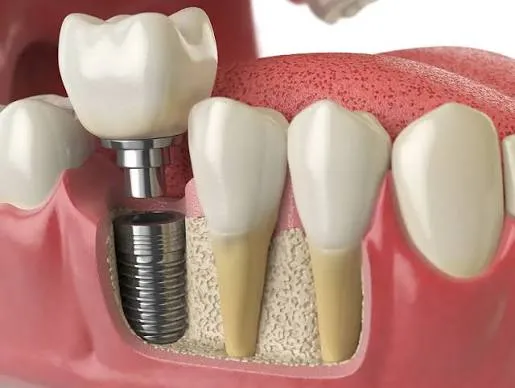
Dental implants — pros, cons, and ideal candidates
A dental implant is a small titanium post placed directly into the jawbone, functioning as an artificial tooth root. Once it fuses with the bone (a process called osseointegration, usually taking 3-6 months), a custom crown is fixed on top. Because it replaces the root as well as the visible tooth, it’s the closest thing to your natural tooth in both function and long-term bone health.
✓ Advantages
- Stands independently — doesn’t touch or weaken neighbouring teeth
- Preserves jawbone density by stimulating bone the way a natural root does
- Long lifespan — the implant post itself is often permanent with good care
- Feels and functions closest to a natural tooth for chewing and speech
✗ Considerations
- Higher upfront cost than a bridge
- Takes longer overall — healing and integration span several months
- Requires a minor surgical procedure under local anaesthesia
- Needs adequate jawbone density (a bone graft can usually solve low density)
Best suited for: patients with one or more missing teeth who want a permanent, standalone solution and whose neighbouring teeth are healthy and best left untouched. Implants are also the foundation for full mouth rehabilitation when several teeth need replacing. Read more on our Implants & Full Mouth Rehabilitation page.
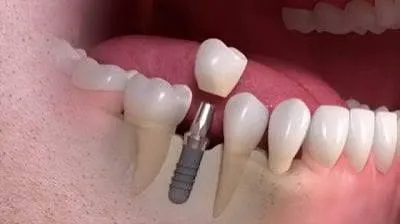
Dental bridges — pros, cons, and ideal candidates
A dental bridge fills the gap with a false tooth (called a pontic) held in place by crowns fixed onto the two natural teeth on either side of the missing one. It’s a well-established, time-tested option that restores your bite and smile without surgery.
✓ Advantages
- Lower upfront cost than an implant
- No surgery — completed in as few as 2-3 visits
- Faster overall treatment timeline, often within 2-3 weeks
- A well-proven, predictable option for suitable cases
✗ Considerations
- Requires reshaping the two healthy neighbouring teeth to fit crowns
- Doesn’t stimulate the jawbone, so bone loss can continue under the gap
- Typically needs replacement every 10-15 years
- Cleaning underneath the bridge needs extra care with floss threaders or a water flosser
Best suited for: patients who want a faster, more budget-friendly fix, whose adjacent teeth already need crowns anyway (making the “cost” to those teeth minimal), or who aren’t good candidates for implant surgery. Bridges are placed as part of our General Dentistry care, with any needed extractions or gum prep handled under Surgical Procedures.
Not sure which fits your case? A quick X-ray tells us most of what we need to know.
Implants vs bridge: side-by-side comparison
| Factor | Dental Implant | Dental Bridge |
|---|---|---|
| Upfront cost | Higher | Lower |
| Typical lifespan | 15-25+ years | 10-15 years |
| Procedure time | Several months (incl. healing) | 2-3 visits, ~2-3 weeks |
| Effect on neighbouring teeth | None — stands independently | Requires reshaping adjacent teeth |
| Jawbone health | Preserves bone density | Bone loss may continue under the gap |
| Maintenance | Brush & floss as normal | Floss threader/water flosser needed under pontic |
| Surgery involved | Yes, minor, under local anaesthesia | No |
Exact figures vary by case — number of teeth involved, implant brand, bone grafting needs, and crown material all affect the final cost and timeline for both options. A consultation and X-ray at Revive Dental gives you a precise, personalised quote rather than a generic estimate.
Cost of dental implants and bridges in Bangalore
A single dental implant cost in Bangalore typically ranges from ₹25,000 to ₹45,000 per tooth at Revive Dental, depending on the implant brand, bone quality, and whether a bone graft or crown is needed. A traditional dental bridge price is usually lower upfront per gap, but factor in that it needs replacing roughly every 10-15 years, while an implant post can last 15-25+ years. For patients considering several missing teeth, ask about all-on-4 dental implants — a full-arch tooth replacement option using just 4 implants per jaw to support a complete set of teeth, often more cost-effective than individual implants for extensive tooth loss. The only way to get an accurate quote for your specific case is a consultation and X-ray — figures shared online (including here) are general ranges, not quotes.
Dental implants & tooth replacement near you
Revive Dental is located on 100 Feet Road, Vajarahalli, Banashankari 6th Stage — and patients regularly travel in from across South Bangalore for implant consultations, bridge work, and full mouth rehabilitation:
Thalaghattapura & Konanakunte
- Single tooth implant consultations and X-rays
- Dental implant price comparisons and case planning
- Bridge vs implant guidance for one or two missing teeth
Doddakallasandra & Raghuvanahalli
- Tooth replacement options for multiple missing teeth
- Full mouth rehabilitation planning and staged treatment
- Bone graft assessment for low jawbone density cases
Wherever you’re travelling from — Balaji Layout, Uttarahalli, or elsewhere along the Kanakapura Road corridor — the first visit is the same: a clinical exam, an X-ray, and a clear implant-vs-bridge recommendation from Dr. Roopa P Gaddagimath before you commit to either option. Read more on dental implants & full mouth rehabilitation near Vajarahalli or explore our full range of dental services.
What Dr. Roopa recommends, based on case type

Dr. Roopa P Gaddagimath, BDS, MDS (Restorative & Cosmetic Dentistry)
“For a single missing tooth with healthy teeth on both sides, I usually recommend an implant — there’s no reason to cut into two perfectly healthy teeth just to fill one gap. A bridge makes more sense when the adjacent teeth already need crowns, when someone needs a faster fix before an event, or when a patient isn’t a candidate for minor surgery. For several missing teeth together, we often look at full mouth rehabilitation planned around implants. There’s no single right answer — it depends on your bone density, your bite, and what you’re prioritising: speed and cost, or long-term bone health.”
Every recommendation at Revive Dental starts with a proper clinical exam and X-ray — not a one-size-fits-all answer. With over 18 years of clinical experience and 5,000+ patients treated, Dr. Roopa plans each case around what will hold up best for you specifically, not just what’s fastest to place.
Frequently asked questions
How long do dental implants last?
With good oral hygiene and regular check-ups, dental implants can last 15-25 years or longer, and the implant post itself is often permanent. The crown on top may need replacement after 10-15 years of normal wear.
Is a bridge cheaper than an implant?
Generally yes, a bridge has a lower upfront cost than an implant. However, since a bridge typically needs replacement every 10-15 years while an implant post can last 15-25+ years, the lifetime cost gap is often smaller than the initial price difference suggests.
Does getting a bridge damage the neighbouring teeth?
A bridge requires reshaping the two teeth on either side of the gap so crowns can be fitted over them. If those teeth are already healthy, this means removing some healthy tooth structure — which is why an implant is often preferred when adjacent teeth don’t already need crowns.
Is a dental implant painful?
No. The implant is placed under local anaesthesia, so the procedure itself is not painful. Mild swelling or soreness for 2-3 days afterward is normal and managed with standard pain medication, similar to a tooth extraction.
Can I get an implant if I have low jawbone density?
Often yes. Low jawbone density doesn’t automatically rule out implants — a bone graft or a shorter/narrower implant can usually solve it. This is assessed with a clinical exam and X-ray during the first visit.
Which is right for replacing multiple missing teeth?
For several missing teeth, implant-supported options (including full mouth rehabilitation) are usually recommended over multiple bridges, since they preserve bone health across the whole jaw rather than just bridging individual gaps.
What is full mouth rehabilitation?
Full mouth rehabilitation is a staged treatment plan that restores all or most of the teeth in a jaw using a combination of implants, crowns, bridges, and gum treatment where needed. It’s planned visit-by-visit around your bone health, bite, and budget rather than done in one sitting.
What are all-on-4 dental implants?
All-on-4 is a full-arch tooth replacement technique that uses just 4 strategically placed implants per jaw to support a complete fixed set of teeth, instead of one implant per missing tooth. It’s often considered for patients missing most or all of their teeth in one jaw.
What does the dental implant procedure involve, step by step?
Broadly: (1) consultation and X-ray to assess bone density, (2) the implant post is placed into the jawbone under local anaesthesia, (3) a healing period of 3-6 months while the implant fuses with the bone, then (4) a custom crown is fitted on top. Each stage is explained beforehand so you know what to expect.
How do I find a trusted implant dentist near me in South Bangalore?
Look for a dentist with clinical experience specifically in implants, KSDC registration, and verified patient reviews. Dr. Roopa P Gaddagimath (BDS, MDS, KSDC-17425-A) has 18+ years of experience and a 5.0★ Google rating from patients across Vajarahalli, Thalaghattapura, Konanakunte, Doddakallasandra and Raghuvanahalli.